

- Published
- November 22, 2026
- Reviewed
- November 22, 2026
- Author
- Gurbaksh Chahal
- Category
- Founder Insights
- Reading
- 10 min
By Gurbaksh Chahal
In January 2025, OpenAI, SoftBank, Oracle and MGX announced Stargate, a company that intends to invest $500 billion over four years in AI infrastructure. Chips, power, land, cooling. Everyone understood the shopping list.
I’m bullish on all of it. Models need somewhere to run.
But I keep coming back to a question that doesn’t get the same airtime:
We’re building the infrastructure to make AI more powerful. Who’s building the infrastructure to make it more capable?
Those are different things. A model can reason through a graduate-level exam, hold a million tokens in context and still fall apart inside an ordinary enterprise workflow. Conflicting records. A policy nobody wrote down. A supplier email that contradicts the system of record. An exception that a ten-year employee handles in thirty seconds.
That model isn’t short on intelligence. It hasn’t done enough of the work.
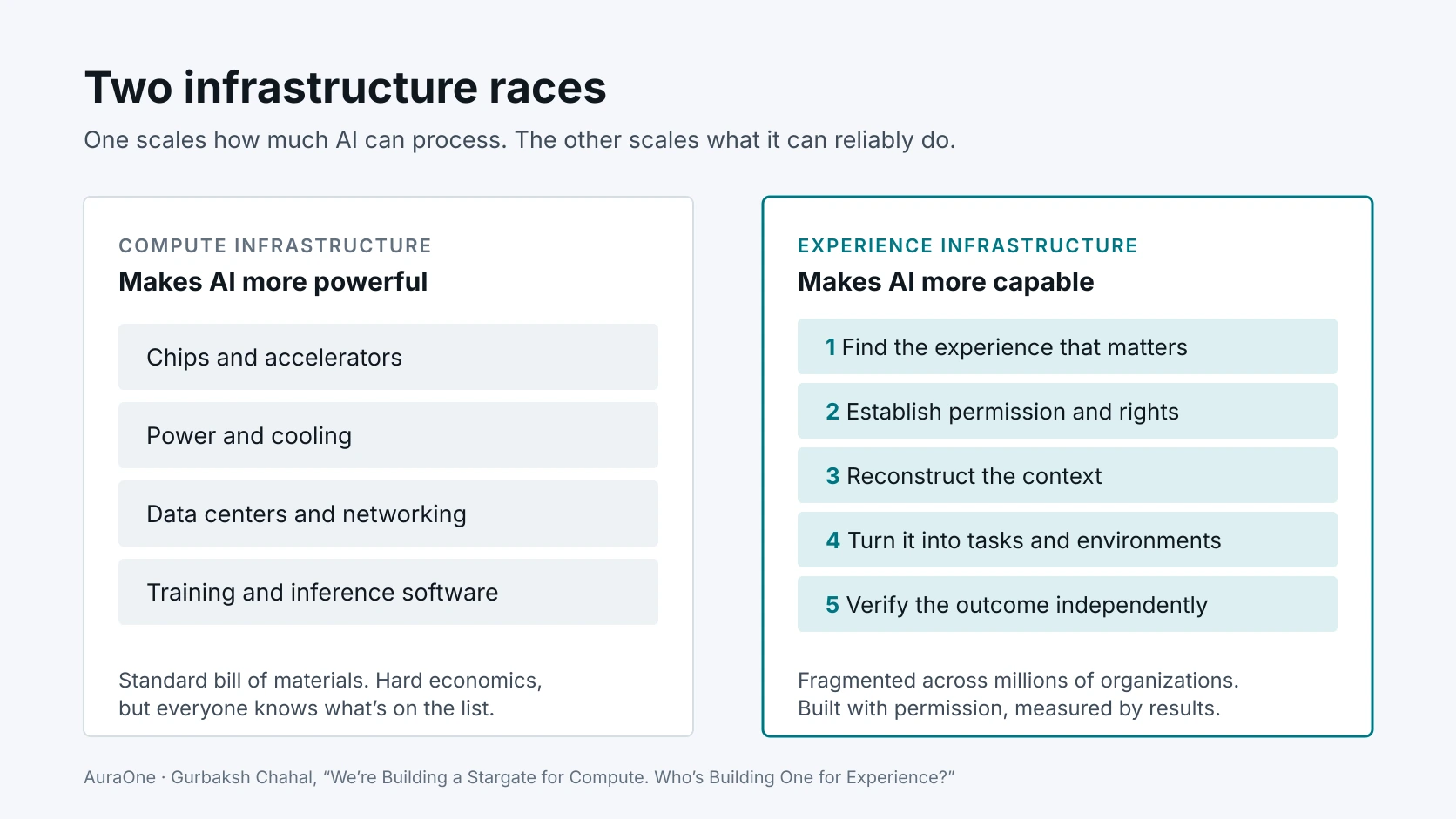
Compute infrastructure scales processing power. Experience infrastructure has to scale useful learning.
Will DePue asked the right question
Will DePue recently published an essay called A Stargate for Data. It’s one of the clearest things I’ve read on where this industry is going, and I’d recommend it to anyone building in AI.
His argument, in short: the internet was a one-time subsidy to deep learning. Decades of books, papers, code and conversations, digitized and freely available, created by people who had no idea they were writing training data. Epoch AI estimates the stock of useful public human text at roughly 300 trillion tokens, and frontier training is closing in on it.
So labs are moving from a compute-limited world to a data-limited one. DePue puts total vendor data spend today at roughly $7 billion a year and expects it to grow more than tenfold, to over $100 billion a year by 2030.
That’s his forecast, not an established market projection. The real number will depend on data efficiency, synthetic generation and research nobody has published yet. But I think the direction is right, and his sharpest line is one I agree with completely:
The speed at which we automate the economy will be limited by our ability to collect data about it.
Where I want to push further is on what we’re actually collecting.
The internet captured what we published. It never captured what we learned by doing.
Think about what happens inside a company on an ordinary Tuesday.
A logistics manager reroutes a delayed shipment because she knows which carrier always misses Friday cutoffs. A financial analyst catches a reconciliation error the software passed. An engineer spends four hours on a failure that isn’t in any runbook. A support lead knows exactly when the refund policy should bend and when it shouldn’t.
There is real intelligence in those decisions. Almost none of it becomes usable training data. It disappears into email threads, ticket comments, spreadsheets, meetings and people’s heads.
DePue calls this the dark matter of the internet. I’d go one step further.
Most of what an AI system needs to perform a job isn’t a fact it can look up. It’s experience: what the situation looked like, what the person considered, what they did, what went wrong, how they recovered and whether the outcome held up.
David Silver and Richard Sutton made a version of this argument in Welcome to the Era of Experience. Their view is that agents will increasingly learn from their own interaction with the world rather than from human-written text. I think that’s where the field ends up. But in a bank, a hospital or a supply chain, you can’t let an agent learn by breaking things in production. Before agents can gather useful experience of their own, someone has to capture human experience, turn it into tasks and environments that can be rerun, and decide what counts as getting it right.
That is the layer I think is missing.
Where I disagree with a pure collection megaproject
DePue proposes a civilizational effort: a census of what data exists, aggressive licensing, even convincing companies to turn off their deletion policies before anyone is buying from them.
I understand the ambition. I don’t think collection alone gets us there, for two reasons.
First, more data isn’t the same as the right experience.
Take two datasets. One has a million generic customer service conversations. The other has 10,000 difficult disputes, each showing what the experienced agent looked at, which policy applied, what mistake almost happened and whether the customer accepted the resolution.
For teaching a specific capability, the second dataset can be worth far more. It’s smaller and it carries the right experience. The future premium will go to knowing which experience closes a particular capability gap, having the rights to use it and being able to prove it helped.
Second, the people who create the experience have to want to participate.
The most valuable operating knowledge belongs to businesses and professionals who spent decades building it. If the AI industry treats that knowledge as something to be extracted, the best sources will close their doors, and they’ll be right to.
A company’s records and outcomes aren’t automatically training assets. Any secondary training or licensing use has to be explicitly authorized under terms the owner agrees to. An expert who contributes judgment should know how it will be used and how they’ll be paid. A lab buying a dataset should know where it came from and what it’s licensed for.
I spent years in an industry where scale outran provenance. I wrote about that in my last essay on AI data’s ad network moment. Advertising eventually had to build standards to prove the traffic was real and the seller had the right to sell it. AI data will go through the same reckoning, and it’s much cheaper to build permission in from the start.
An infrastructure layer for experience
A data center has a fairly standard bill of materials. The economics are hard, but everyone knows what’s on the list.
Real-world experience doesn’t work that way. It’s fragmented across millions of organizations, each with its own systems, vocabulary, constraints and definition of success. Much of it is confidential or regulated.
Turning it into something a model can learn from takes a different kind of supply chain:
- Find the experience that matters. Not everything a company does is worth teaching. The valuable part is usually the hard cases: the exceptions, the recoveries, the judgment calls.
- Establish permission. Clear rights for the source owner, the contributor and the buyer, with the ability to exclude or recall material later.
- Reconstruct the context. The starting state, the information available, the tools used and the decision made, assembled from scattered systems.
- Turn it into practice. A task or environment where a model can attempt the same problem, with variations and new exceptions, and be reset.
- Verify the outcome. A way to check that the model completed the work, rather than satisfying a grader or producing a convincing paragraph about it.
Here’s a concrete example. A retailer receives updated product specifications from a supplier. The dimensions don’t match the inventory system. A second document lists different packaging. The live product listing is now wrong.
An experienced employee works out which source is authoritative, corrects the record and gets the change approved.
Every step of that is learnable: the discrepancy, the evidence reviewed, the decision, the correction, the approval and the final state. With the retailer’s permission, it can become a repeatable task that tests whether an AI agent can resolve the next hundred discrepancies like it, and catches the ones where it can’t.
The same pattern shows up everywhere. In finance, it’s exception handling and reconciliation. In engineering, it’s real troubleshooting histories that synthetic examples would never anticipate. In robotics, it’s the failed grasp and how the operator recovered, not just the clean demonstration.
All of these share one property. You can’t produce them by asking another model to generate more content.
The last few percent will be the most expensive
DePue makes an O-ring argument I find persuasive: a dataset that buys a one-point improvement can justify an enormous collection cost if it’s the difference between a system that does 99% of a job and one that does all of it.
I’d add that the remaining failures aren’t random. They cluster in the same places: unusual circumstances, conflicting instructions, missing information, tool failures, changing regulations and situations where the obvious answer is wrong.
A model that handles 80% of a workflow is a useful assistant. At 95%, it can support real automation with oversight. A system approving payments, touching patient records or changing production infrastructure needs reliability that matches the cost of being wrong.
The fix isn’t always more training. Sometimes it’s a better tool, a tighter permission boundary, a different workflow or a clear handoff to a qualified person. You only know which one you need if you have evidence from the work itself.
The first 90% of a job can be learned from what the world published. Making the last 10% dependable takes experience that was never written down.
The real moat is the learning loop
Over the next few years, frontier models will keep improving, compute will expand and more companies will have access to powerful models. None of that gives everyone the same specialized learning experiences.
But owning a static dataset isn’t a permanent advantage either. Models absorb what’s useful in it. Competitors build substitutes. The problems that matter change.
What lasts is the ability to keep finding new capability gaps and producing evidence you can trust that closes them.
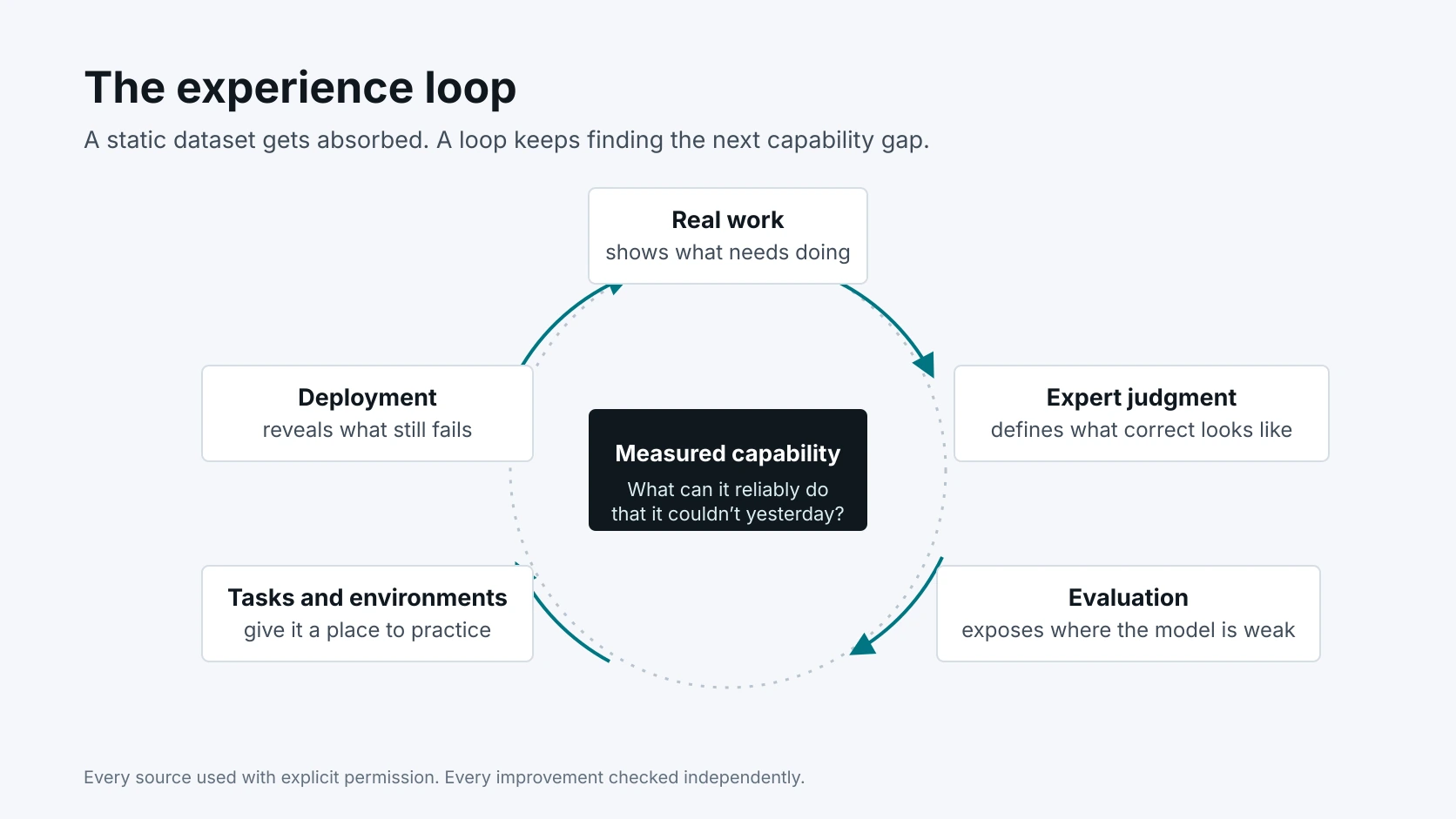
The experience loop. Each turn should leave the next task better chosen and easier to verify.
Real work shows what needs to be done. Expert judgment establishes what correct looks like. Evaluation exposes where the model is weak. Tasks and environments give it a place to practice. Deployment reveals what still doesn’t work. Then the loop starts again.
I think the data companies that matter in five years will look less like labeling operations and more like learning infrastructure. They’ll help customers answer one question:
What can my AI system reliably do today that it couldn’t do yesterday, and how do we know?
How we’re building AuraOne around this
That loop is how we think about AuraOne.
Human Data captures and reviews expert judgment, demonstrations and licensed operating history, with the rights attached. Agent Traces, Foundry and RL Environments turn real failures into tasks and environments a model can practice in. Evaluation Studio and Model Improvement measure whether any of it worked. Enterprise Intelligence puts AI into real business workflows with human review where it matters, which is where we see what still breaks.
To me, these are parts of one system, not a product catalog.
And we hold ourselves to the same rule I described above: a customer’s records and outcomes are theirs. Nothing becomes training or licensing material without explicit authorization under agreed terms.
We’re early, and we still have to prove this through quality, repeat orders and measured results. That’s the right test. Our goal isn’t to accumulate the biggest pile of data. It’s to turn legitimate real-world experience into AI capability we can measure.
The second infrastructure race
The first AI infrastructure race gave machines enough compute to learn from what the world had written down.
The second one is about giving them enough verified experience to operate in it.
That experience has to come from somewhere: experts, businesses, real workflows, controlled environments, physical demonstrations, mistakes, corrections and outcomes. It has to be gathered with permission, checked independently and measured by whether AI can do something valuable, reliably, that it couldn’t do before.
DePue asked what a Stargate for data would look like. My answer is that it won’t be one giant repository. It will be a supply chain that connects real work to model training, and that the people who did the work choose to join.
We’re at the very beginning of building it.
Gurbaksh Chahal is the Founder and CEO of AuraOne, which connects human expertise, real-world experience, model evaluation and enterprise workflows to measurable AI outcomes.
AI teams working on model capabilities can explore AuraOne’s programs for AI labs. Businesses curious about the value of their operating experience can scope a data partnership.