
- Role prompt
- No identity
- No evidence
- No provenance
- Disposable conversation
AuraOne / Products
Loading the product.
Loading capabilities, workflow, and program details.
AuraOne / Products
Loading capabilities, workflow, and program details.
AuraOne / Synthetic Research
Turn the market you need to understand—or the people and research you already know—into a synthetic professional population you can question again and again.
Evidence underneath every respondent. Methodology beside every result.
What would change your adoption decision?
The old way
The interview ended. The survey closed. Then the next question arrived—and the work began again.
The study ends. The intelligence does not.
Three ways to begin
Use population evidence, an authorized named cohort, or real human research. Combine them when the study calls for it.
Build the market
Define a professional audience—such as 5,000 U.S. healthcare CFOs—then ask the population structured and open-ended questions.
Population priors and modeled respondentsModel actual people
Start with an authorized expert list. AuraOne resolves identities and builds evidence-grounded synthetic counterparts without turning a cohort prior into a claim about a real person.
Named cohort with explicit unknownsBring humans
Add approved interviews or survey responses for calibration and independent comparison. Human validation is study-specific and reported only when the protocol and data qualify.
Calibrated cohort when eligibleOne study, two kinds of intelligence: compatible structured questions run through decision-native models, while open-ended questions stay on the generative respondent path.
No panel? Start with the real world.
AuraOne does not ask a model to invent 5,000 CFOs from scratch. It constructs the population from documented professional, company, and population evidence—then records what came from evidence and what remains modeled.
Every population carries visible evidence grade, methodology status, and source lineage.
Use the right engine for the question
Compatible structured questions are routed through decision-native models that return probability distributions; open-ended questions stay generative. For compatible instruments, AuraOne preserves the full answer distribution, then realizes reproducible synthetic responses under the study's frozen simulation seed.
Decision-native answers do not establish representativeness, and they never turn cohort priors into facts about a real person. Calibration and independent human validation remain study-specific, and limitations travel with every result. See the methodology in the fictional walkthrough.
Reproducible responses under a frozen simulation seed
Same population, same evidence, same study context
Which engine answered each question · the evidence behind it · the methodology applied
A question worth asking
Run the first study tonight. Re-ask it tomorrow. Keep the cohort. Compare what changes.
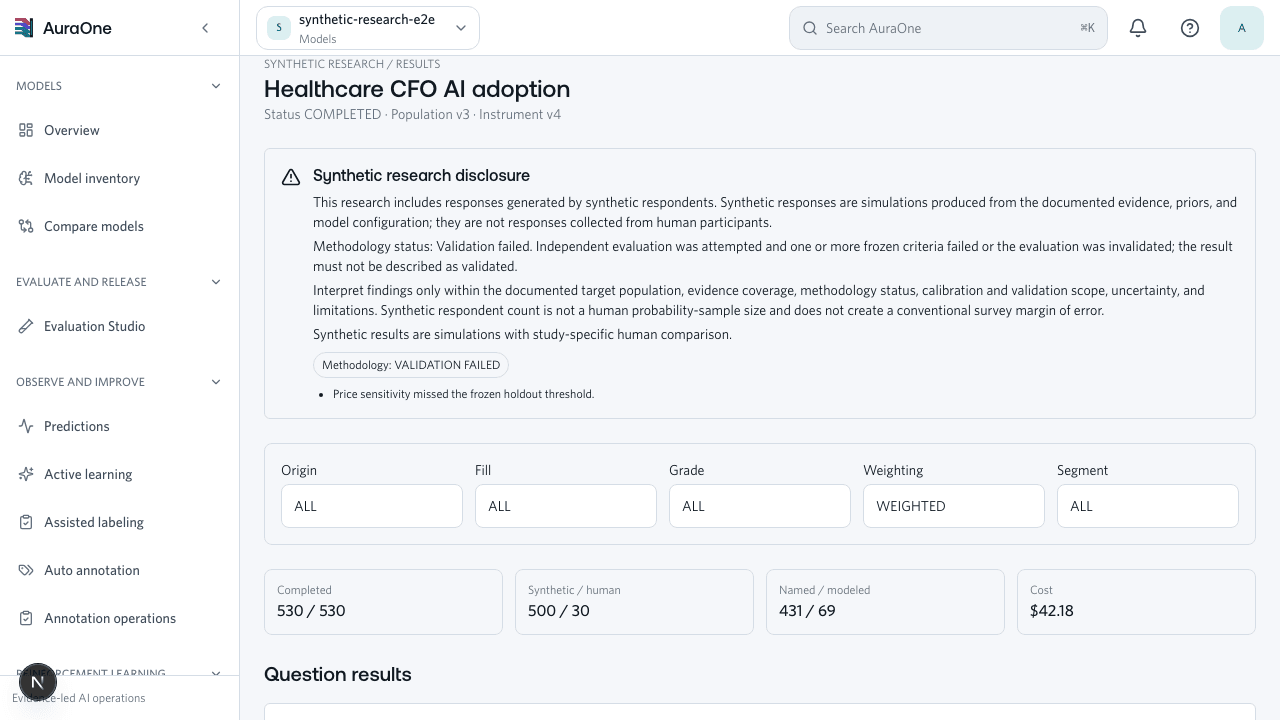
Five hundred synthetic respondents. Thirty human comparisons. One disclosed result.
Named cohorts
Begin with an authorized expert list. AuraOne resolves identities, separates named counterparts from modeled fill, and shows the evidence and unknowns behind every persona.
Not a prompt pretending to be a CFO. A disclosed synthetic counterpart grounded in the professional you wanted to research.
Why not just prompt a persona?
Human + synthetic
Add approved interviews or surveys. Calibrate the population. Hold humans back for independent comparison. Report where the result holds—and where it does not.
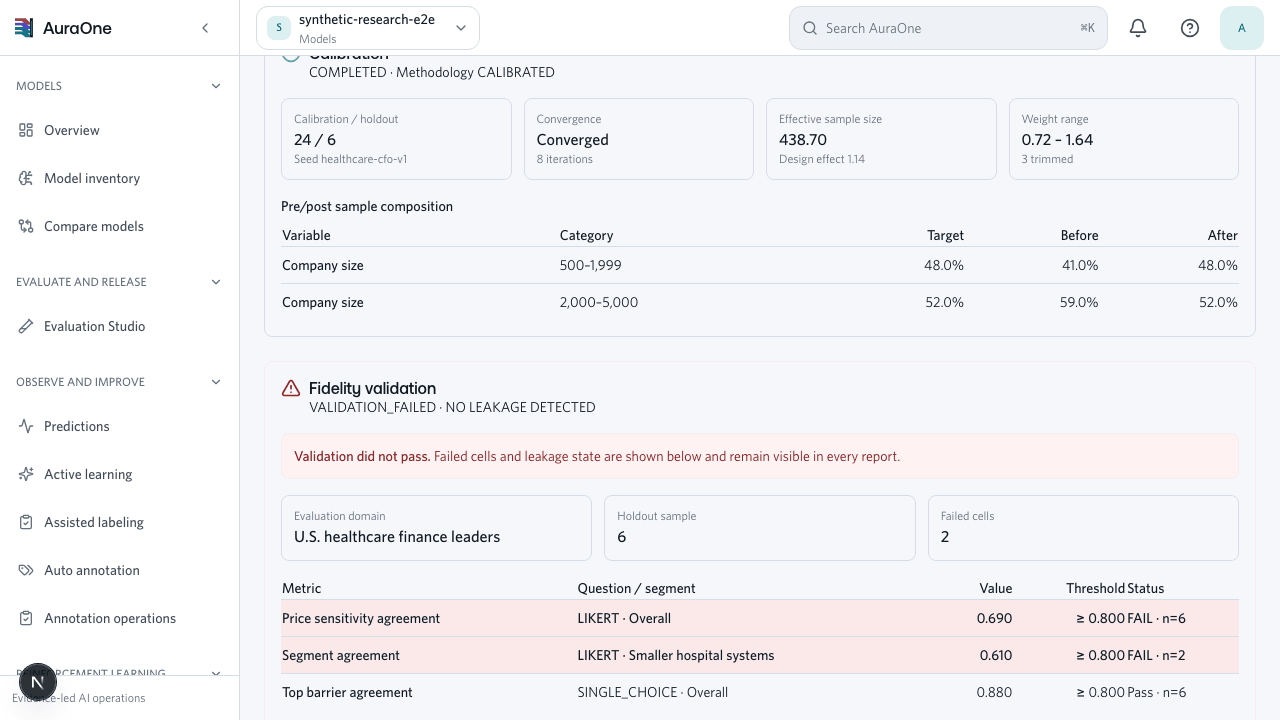
Calibration is visible. Failure is visible. Limits travel with the result.
Persistent respondents
Traditional research expires. AuraOne keeps the population, evidence, and study context available for the next question.
For research companies
Keep the relationship. Keep the expertise. Deliver studies that keep answering, richer follow-up, and a reusable synthetic audience.
You own the research relationship. AuraOne powers the synthetic layer.
Build the partner offeringFidelity grows with evidence
Begin with market structure. Add people. Add research. Add permission. AuraOne keeps each level distinct.
Built from documented market structure.
Grounded in the people you need to understand.
Adjusted and compared with approved research.
Measured against a sealed human holdout.
Permissioned individual evidence
Expert Twin candidate
Individually validated Expert TwinEvery answer carries receipts
Persona versions keep observed evidence, derived facts, cohort priors, model priors, contradictions, and unknowns separate. Results disclose their methodology status and limitations.
The Human Data flywheel
Deidentified aggregate signals can strengthen population priors. Individual evidence enters named representations only with explicit permission and the required validation. Human judgment remains in the loop wherever it matters.
We'll build the research environment.
AuraOne builds evidence-grounded synthetic professional populations for disclosed research workflows; calibration and independent human validation are study-specific and reported only when available.
Synthetic respondents are simulations, not the actual people represented. Named-person outputs describe a disclosed simulation—not that person's actual beliefs or future behavior. Results are directional unless the study's frozen methodology establishes another status.