
- Published
- September 1, 2026
- Reviewed
- October 14, 2026
- Author
- AuraOne editorial
- Category
- Enterprise Intelligence
- Reading
- 24 min
The Internet taught AI what humans know. The next data layer will teach AI how humans actually work.
The first chapter of modern AI was built on human knowledge.
Books. Websites. Code. Research papers. Images. Audio. Video. Documents. Conversations.
Models absorbed an extraordinary record of what humanity had written, explained, created and published.
That gave us systems capable of answering questions, generating software, creating images, summarizing documents, reasoning across complex information and interacting with people in increasingly natural ways.
But AI is now entering a fundamentally different phase.
The question is no longer simply: Can the model generate a convincing answer?
Can the model actually do the work?
Can it:
- understand an assignment,
- use the right tools,
- navigate multiple systems,
- make decisions,
- recognize when something has gone wrong,
- recover,
- and complete the task?
Most importantly, can we prove that the work was done correctly?
At AuraOne, we believe this transition changes the data problem at the center of artificial intelligence.
The next major bottleneck will not simply be access to more tokens, more parameters, more compute or more raw data.
It will be access to verifiable work.
AI needs realistic environments in which it can attempt meaningful tasks, receive useful feedback, encounter failure and learn the difference between producing something plausible and delivering an accepted outcome.
That shift changes almost everything.
It changes human data.
It changes evaluation.
It changes synthetic data.
It changes robotics.
It changes enterprise AI.
And ultimately, it changes what customers will pay for.
AI Is Moving From Content to Work
The progression is already visible.
Content → Tasks → Workflows → Operations
- Content is generated.
- A task is completed.
- A workflow coordinates multiple tasks.
- An operation runs continuously, handles exceptions and delivers reliable outcomes over time.
The farther AI moves along that progression, the less sufficient raw intelligence becomes.
A model may be able to explain how an invoice discrepancy should be resolved.
That does not mean it can actually resolve one.
A production system may need to:
- locate the invoice,
- find the relevant purchase order,
- inspect supplier records,
- identify the discrepancy,
- apply the correct policy,
- determine approval authority,
- gather supporting evidence,
- decide whether the issue can be resolved automatically,
- escalate when necessary,
- update the appropriate system,
- document the decision,
- and produce a result that satisfies the company’s definition of done.
That is no longer question answering.
That is work.
And real work introduces something generative AI has historically been able to avoid:
accountability to an outcome.
A polished paragraph can sound right.
A business process has to actually be right.
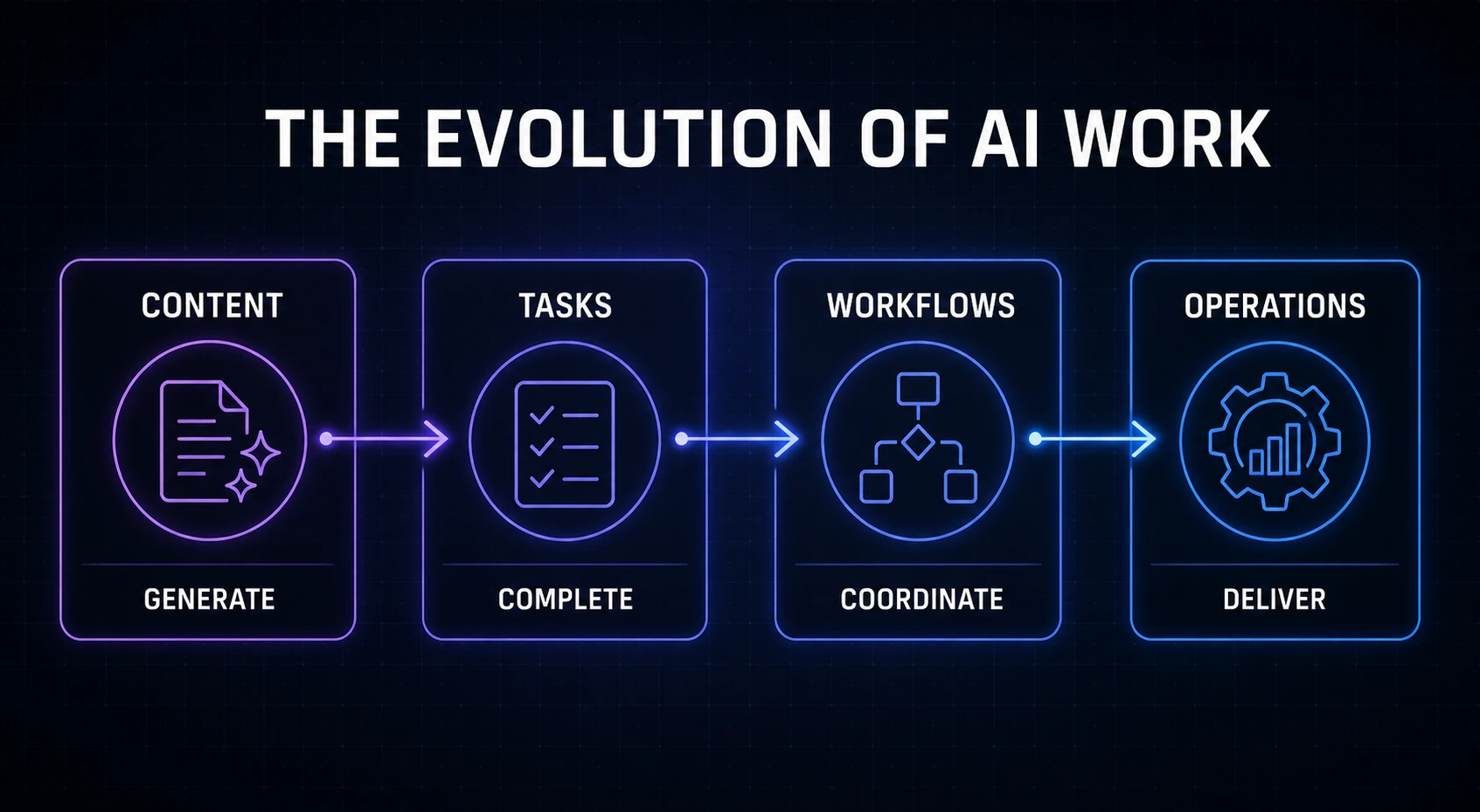
Figure 1. AI moves from generated content to accountable operations: generate, complete, coordinate, deliver.
The Unit of AI Data Is Changing
For much of the recent AI era, the basic unit of human-generated training data looked something like:
Prompt → Response → Rating
A person answered a question.
Another person evaluated the answer.
The system learned from those preferences.
That structure has been enormously useful.
But AI agents performing long-horizon tasks require richer forms of experience.
The more useful unit increasingly looks like:
Environment → Task → Actions → Decisions → Outcome → Verification
The distinction matters.
The final answer may tell us whether the model arrived somewhere useful.
The trajectory tells us how it got there.
What information did it inspect?
What did it ignore?
Which tools did it use?
Which assumptions did it make?
Where did it hesitate?
Did it recover after failure?
Did it escalate appropriately?
Did it follow policy?
Did it reach the correct state for the correct reasons?
That record can contain far more learning signal than the final output alone.
The next generation of AI does not only need examples of correct answers.
It needs experience performing work.
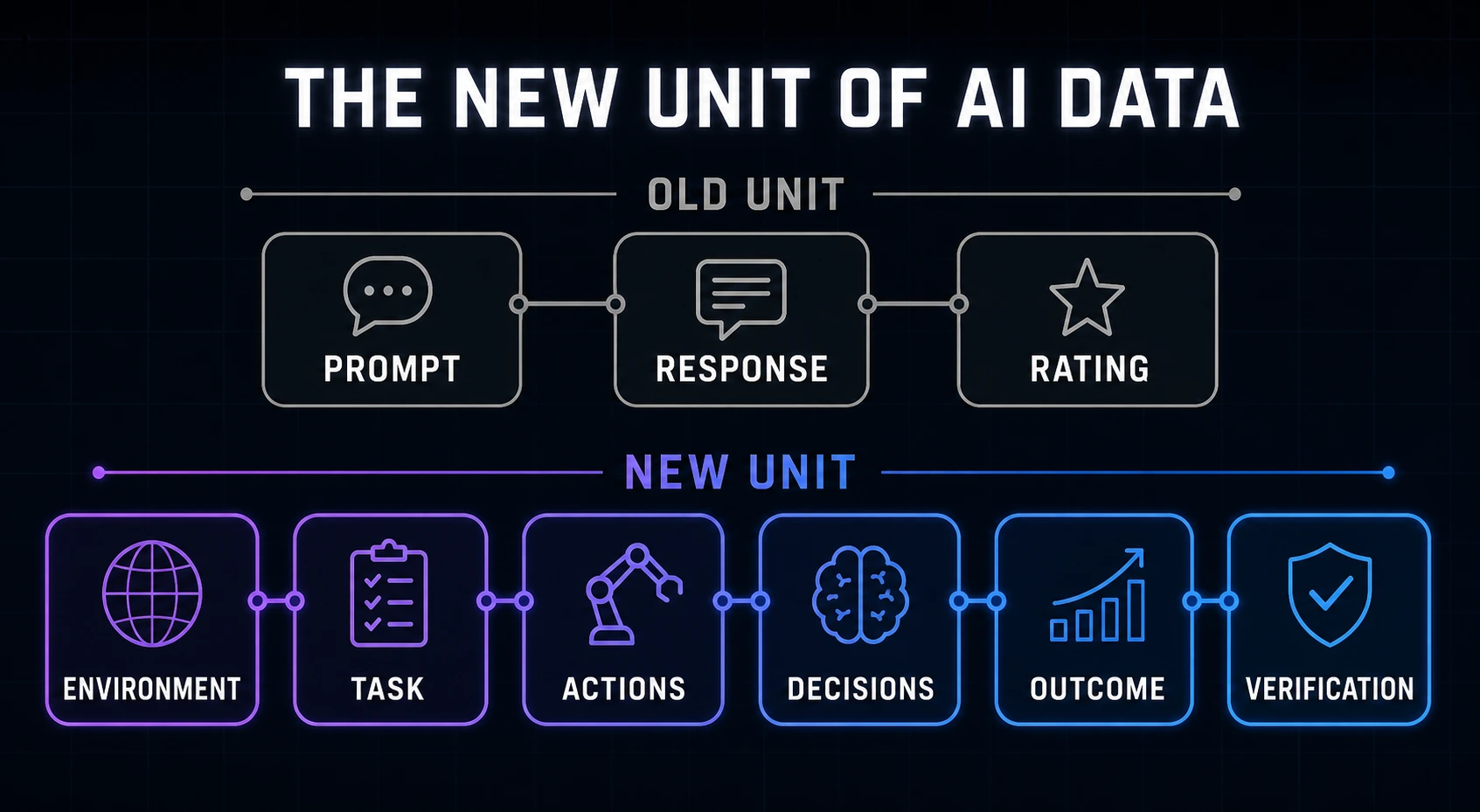
Figure 2. The useful training record expands from a rated response to a verified work trajectory.
The Starting Point Should Be the Capability Gap
Traditional data projects often begin with volume.
How many contributors?
How many annotations?
How many hours of audio?
How many videos?
How many examples?
We believe increasingly valuable AI-data programs will begin somewhere else:
What can the system not reliably do today?
That is the capability gap.
A financial model may perform well on routine analysis but fail when records conflict.
A coding agent may solve isolated programming problems but collapse when a task spans multiple repositories and tools.
A voice system may perform well in controlled conditions but fail during interruptions, noise or code-switching.
A robot may reliably manipulate rigid boxes but struggle with deformable objects.
An enterprise agent may successfully process normal cases but fail whenever policy exceptions appear.
These are not simply accuracy problems.
They identify the current boundary of the system.
Once that boundary is understood, a much more useful loop becomes possible:
Evaluate → Identify Failure → Capture Expertise → Create Experience → Train → Re-evaluate
The goal is not merely more data.
The goal is moving the capability boundary.
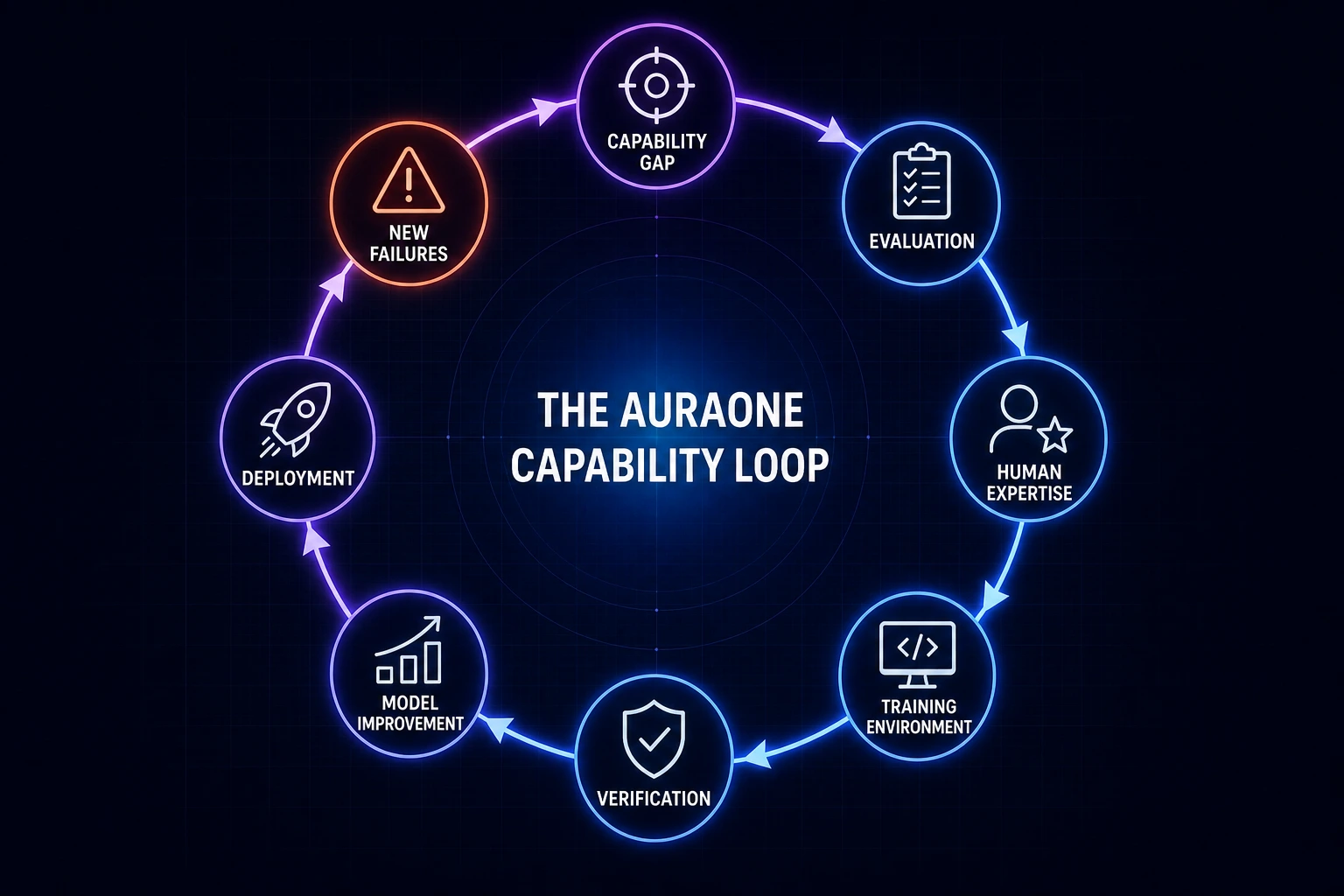
Figure 3. Capability development is an iterative loop: evaluate the gap, create experience, verify improvement, deploy, and learn from new failures.
Evaluation Becomes Part of the Data Product
Before a capability can be improved, it has to be measured.
That makes evaluation a first-class part of modern AI infrastructure.
An evaluation should not simply produce one benchmark score.
A useful evaluation should help answer:
- Where is the model failing?
- Which failures matter?
- Which failures are systematic?
- Which failures are rare?
- Which tools cause problems?
- Which reasoning steps are unreliable?
- Does the model understand when it is uncertain?
- Can it recover after making a mistake?
- Does it follow permissions and operating constraints?
- Does it produce enough evidence for someone else to verify the result?
Imagine that an AI system receives an overall score of 72%.
That number alone is not especially useful.
Now imagine we discover instead:
- 97% accuracy on information retrieval,
- 92% on calculations,
- 86% on routine workflow execution,
- 58% when systems contain conflicting information,
- 44% on exception handling,
- 31% on recognizing when escalation is required.
Now there is a roadmap.
The evaluation tells us what kind of data needs to exist next.
This is why evaluation and data generation are increasingly becoming part of the same product.
You evaluate to identify the failure.
You generate data around the failure.
You train.
Then you evaluate again.
The Real Product Is Capability Improvement
This changes the economics of AI data.
A customer does not fundamentally want:
100,000 annotations.
50,000 expert responses.
10,000 demonstrations.
Five million synthetic examples.
Those may be necessary inputs.
But they are not the end product.
A frontier AI lab wants its model to become better at something.
A robotics lab wants a machine to acquire a new capability.
A voice company wants its system to succeed in conditions where it currently fails.
An enterprise wants more work completed correctly.
The data is the mechanism.
Capability improvement is the product.
That means a modern AI-data system should increasingly be able to answer:
What can the system do today?
Where does it fail?
Which failures are economically important?
What training intervention might fix them?
What examples need to be created?
How will correctness be measured?
Did the intervention improve the system?
Does the improvement hold on unseen tasks?
That is a very different business from traditional labeling.
It is closer to infrastructure for capability development.
Coding Showed Us What Happens When Data Meets Verification
Software engineering has become one of AI’s most successful professional domains for a reason.
There is enormous amounts of code available.
But code also has another unusual property:
it is frequently verifiable.
Did the program run?
Did the test pass?
Did the bug disappear?
Did the output match the specification?
Did performance improve or regress?
A coding model can attempt something and receive relatively objective feedback.
That creates ideal conditions for learning.
The deeper lesson is not simply that AI is good at programming.
The lesson is that AI improves rapidly when three things come together:
realistic tasks + clear outcomes + reliable verification.
Most professional work does not yet have the equivalent of this infrastructure.
There is no GitHub containing hundreds of millions of structured examples showing exactly how the world’s best professionals:
- close the books,
- underwrite complex risk,
- investigate a compliance issue,
- diagnose industrial equipment,
- resolve a difficult logistics exception,
- conduct scientific research,
- evaluate a supplier,
- or navigate a complex enterprise workflow.
Yet AI is increasingly being asked to perform those jobs.
That creates an enormous missing dataset.
The Economy Is the Missing Dataset
The Internet contains an extraordinary amount of information.
But information and experience are not the same thing.
A website can explain how industrial equipment is repaired.
That does not necessarily show:
- the state of the machine when the failure began,
- what symptoms were observed,
- which diagnostic possibilities were considered,
- what information the technician inspected,
- which tools were used,
- which attempts failed,
- what ultimately solved the problem,
- and whether the equipment operated correctly afterward.
That experience exists.
It happens every day.
But historically, most of it has disappeared.
The same is true across almost every industry.
Finance.
Insurance.
Healthcare.
Manufacturing.
Energy.
Logistics.
Retail.
Construction.
Science.
Agriculture.
Software.
Professional services.
Every day, millions of people perform work containing judgment, reasoning, corrections, decisions, exceptions and outcomes.
Most of that activity has never been structured as training material.
This may represent one of the largest untapped sources of useful AI data in the world.
The Internet taught machines what humans had recorded.
The economy contains what humans actually do.
Real Work Can Become a Training Environment
Consider an accountant.
Instead of asking:
“How should this account be reconciled?”
a realistic training environment can contain:
- spreadsheets,
- invoices,
- bank records,
- historical transactions,
- accounting policies,
- approvals,
- internal systems,
- missing information,
- and discrepancies.
The AI must actually perform the assignment.
It inspects files.
It makes decisions.
It uses tools.
It changes records.
It gathers evidence.
It produces an outcome.
And the environment can determine whether the result satisfies the task.
The same structure can apply to:
financial analysis,
insurance,
procurement,
legal operations,
scientific research,
cybersecurity,
customer operations,
software development,
manufacturing,
and many other professional domains.
These become something like training simulators for AI.
A high-quality professional task environment can contain:
- a realistic objective,
- an initial state,
- relevant records,
- required tools,
- operating constraints,
- permission boundaries,
- multi-step dependencies,
- hidden information that must be discovered,
- expert reference outcomes,
- acceptable alternative outcomes,
- automated tests,
- professional rubrics,
- known failure modes,
- exception scenarios,
- adversarial variations,
- model trajectories,
- human corrections,
- and a final acceptance record.
Once created, that environment can become useful for much more than one training run.
It can support:
- post-training,
- reinforcement learning,
- model comparison,
- agent evaluation,
- regression testing,
- safety testing,
- release decisions,
- and production monitoring.
That makes a verified task environment a durable asset rather than a disposable annotation.
Verification May Become One of the Most Valuable Layers of AI Infrastructure
Reinforcement learning becomes far more powerful when a system can determine whether a task succeeded.
That makes verification critical.
Sometimes success is easy to check.
Did the numbers reconcile?
Did the test pass?
Was the correct record updated?
Was the required document produced?
Other tasks require professional judgment.
Did the model reach the right conclusion?
Did it use the correct evidence?
Did it follow the proper procedure?
Did it violate policy?
Did it overlook an important risk?
Would an experienced practitioner accept the result?
The closer we get to a dependable definition of success, the easier it becomes to create valuable learning signals.
This leads to an important principle:
If success can be clearly defined, it can increasingly become a training signal.
This is where graders, rubrics, experts, automated tests and accepted outcomes become foundational infrastructure.
Failures May Be More Valuable Than Successes
AI systems generate mistakes constantly.
The instinct is often to discard them.
We believe that wastes some of the most valuable information the system produces.
A failure identifies the boundary of current capability.
When an expert reviews the failure and determines:
- what went wrong,
- why it went wrong,
- what should have happened,
- what evidence mattered,
- and what the accepted result looks like,
the failure becomes a reusable asset.
It can become:
- a corrected training example,
- an evaluation case,
- a regression test,
- an edge-case benchmark,
- a new verifier,
- or an escalation rule.
This creates one of the most important loops in AI:
AI attempts work → AI fails → Human resolves it → Resolution becomes data → Future AI is tested against it
Yesterday’s mistake becomes tomorrow’s exam.
And over time, a system can accumulate a structured library of its own weaknesses.
That library can become part of how future versions improve.
Human Expertise Is Moving Up the Stack
As models become capable of generating more synthetic examples, candidate answers and task variations, basic data production will become increasingly automated.
That does not eliminate the need for human expertise.
It changes where human judgment creates the most value.
The role moves:
- from mass labeling → to task design
- from answer production → to expert verification
- from evaluating isolated responses → to evaluating complete trajectories
- from creating volume → to identifying failure boundaries
- from reviewing every output → to calibrating automated judges
- from generic annotation → to specialized professional judgment
- from basic QA → to independent evaluation
Humans become increasingly responsible for questions machines cannot safely answer about themselves:
Is this task realistic?
Is it actually difficult?
Is the expected answer correct?
Did the system solve the problem or exploit the evaluator?
Does the automated grader agree with experienced practitioners?
Which edge cases are missing?
Would a professional accept the outcome?
Is this system ready for production?
Can the evaluation itself be trusted?
The number of human decisions per task may decrease.
But the importance of those decisions increases.
Human expertise becomes the calibration layer against which automated intelligence is measured.
Synthetic Data Needs Ground Truth
Synthetic data will be essential to the next generation of AI.
Models can generate enormous numbers of:
tasks,
scenarios,
conversations,
candidate solutions,
simulated populations,
variations,
and edge cases.
That scale is impossible to reproduce using humans alone.
But scale is not the same thing as truth.
A model can generate millions of examples while repeating:
the same assumptions,
the same blind spots,
the same demographic gaps,
the same unrealistic behaviors,
and the same underlying errors.
The critical questions therefore become:
Does the synthetic population resemble reality?
Are important groups represented?
Do the scenarios reflect real professional work?
Are meaningful edge cases covered?
Is the task genuinely solvable?
Does the verifier measure the right thing?
Is the model finding shortcuts?
Are synthetic conclusions calibrated against actual outcomes?
Can the process be reproduced and audited?
At AuraOne, we believe synthetic generation and human verification belong together.
Models generate possibilities.
Real-world evidence, expert judgment and verification determine which of those possibilities are useful.
Without grounding, synthetic data risks becoming model-generated assumptions training future models on the same assumptions.
With strong evaluation and calibration, synthetic data becomes something much more powerful:
A renewable source of increasingly difficult training experience.
Independent Evaluation Becomes More Important as AI Becomes More Autonomous
When AI provides a suggestion, a human can inspect it before acting.
When autonomous systems begin taking thousands of actions across enterprise systems, reviewing every step becomes impossible.
The question changes.
It is no longer only:
Can the model produce a good answer?
It becomes:
Can the system operate reliably without constant supervision while preserving enough evidence for someone to verify what happened?
Long-horizon AI systems need to be evaluated across:
- goal consistency,
- planning,
- task decomposition,
- permission boundaries,
- tool selection,
- intermediate decisions,
- recovery from errors,
- escalation behavior,
- human-intervention rates,
- verifier accuracy,
- evidence quality,
- final acceptance,
- and repeated performance over time.
And as AI is deployed into increasingly consequential environments, model developers cannot be the only parties determining whether their own systems are reliable.
Trust requires evidence.
That means the industry will increasingly need:
private evaluations,
contamination-resistant test sets,
qualified domain specialists,
explicit acceptance criteria,
human adjudication,
reproducible evidence,
release gates,
auditable approval records,
and continuous regression testing.
Trust should be demonstrated, not assumed.
Physical AI Makes the Data Problem Even More Obvious
Language models had the Internet.
Robots do not have an equivalent corpus of physical experience.
A robot cannot learn how to operate in every real environment simply by reading descriptions of physical work.
It needs to see.
Move.
Interact.
Fail.
Recover.
And try again.
Consider unloading a truck.
A human handles thousands of variables almost unconsciously:
objects of different sizes,
different weights,
damaged packaging,
poor lighting,
unstable stacks,
unusual shapes,
slippery surfaces,
people moving nearby,
unexpected obstructions,
and countless combinations that may never appear twice in exactly the same form.
Robots have to learn these cases.
That requires a new class of data.
Egocentric Data Captures How Humans Move Through the World
One important source is first-person or egocentric capture.
A person performs a real task while cameras and sensors record the activity from the operator’s perspective.
The dataset can preserve:
what the person saw,
where attention moved,
which objects were involved,
what actions were performed,
how the environment changed,
where failure occurred,
and whether the task succeeded.
This turns human physical activity into machine-learning experience.
Teleoperation Creates Another Powerful Learning Loop
Teleoperation provides another source of embodied demonstrations.
A human directly controls a robot while performing a task.
The system can record:
- camera feeds,
- robot motion,
- joint positions,
- gripper state,
- timing,
- operator actions,
- sensor streams,
- environmental context,
- failures,
- and outcomes.
The human first drives the robot.
Those demonstrations then help teach the machine to perform more of the work autonomously.
But raw recordings alone are not enough.
Physical AI Requires Outcome-Verified Experience
A folder containing thousands of videos is not automatically a valuable robotics dataset.
A useful embodied task episode should explain:
- what the environment looked like initially,
- what needed to happen,
- which objects and tools were involved,
- what actions occurred,
- whether the attempt succeeded,
- where failure happened,
- how the human recovered,
- what the final state looked like,
- and how success was verified.
That is the idea behind AuraOne Capture.
The objective is not simply to collect footage.
It is to create outcome-verified embodied task episodes.
A verified episode can combine:
- first-person video,
- synchronized sensor streams,
- task instructions,
- initial and final states,
- tool interactions,
- success criteria,
- failed attempts,
- corrective demonstrations,
- automated quality checks,
- and human review.
The final product is not a video.
It is physical-world experience packaged in a form that can help train and evaluate embodied systems.
Specialized Robotics Can Create Powerful Data Flywheels
A universal robot that does everything is extraordinarily difficult to build.
A system designed around one valuable class of tasks can develop a different advantage.
Every deployment generates new experience.
Imagine a warehouse robot.
It performs work.
It encounters a new object.
It struggles.
A human intervenes.
The intervention becomes new data.
The system improves.
The improved system performs more work.
More work produces new edge cases.
Those edge cases create additional training opportunities.
The loop becomes:
Deployment → Data → Improvement → More Deployment → More Data
The data created through operation becomes part of the moat.
Voice AI Has the Same Problem in a Different Form
Voice models have already consumed enormous amounts of speech.
But a production voice agent needs to do much more than recognize words.
It needs to navigate:
accents,
dialects,
industry vocabulary,
background noise,
interruptions,
overlapping speakers,
emotion,
cultural context,
code-switching,
ambiguity,
misunderstandings,
and conversational repair.
The difficult data often exists exactly where the system breaks.
And the higher-value unit is not simply an audio clip.
It is a verified interaction.
That might include:
- the speaker’s objective,
- linguistic context,
- cultural context,
- emotional tone,
- interruptions,
- ambiguity,
- expected behavior,
- successful responses,
- unsuccessful responses,
- task completion,
- and expert evaluation.
As voice agents increasingly perform customer service, sales, education, intake and operational workflows, natural speech alone is not enough.
The system has to understand the person and complete the correct task.
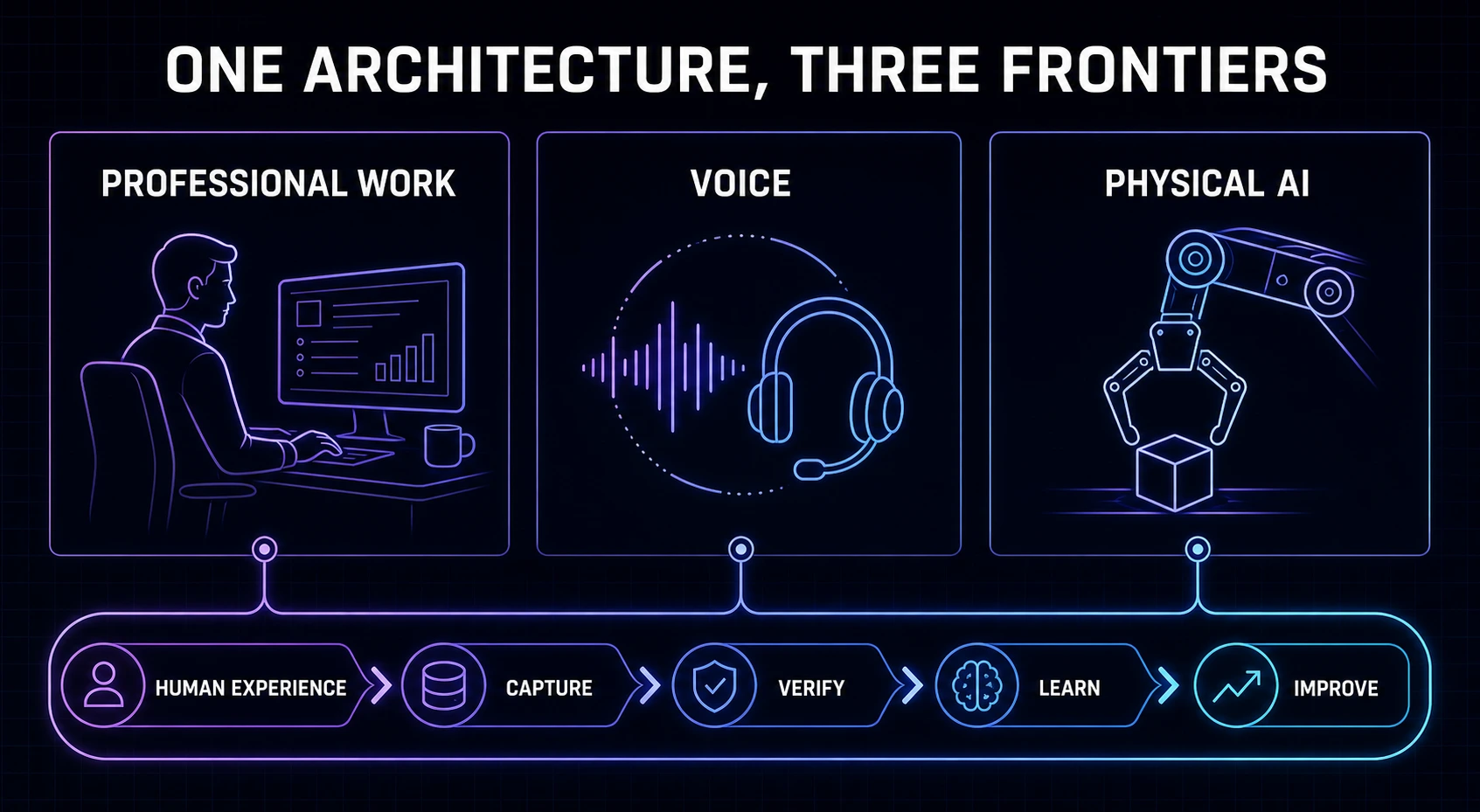
Figure 4. Professional, voice, and physical AI programs share the same underlying architecture: human experience, capture, verification, learning, and improvement.
Enterprises May Possess Some of the Most Valuable AI Data in the World
The same transformation extends beyond AI labs.
Every organization generates a proprietary history of work.
Banks have fraud decisions.
Insurers have underwriting decisions and claims.
Manufacturers have equipment failures and maintenance histories.
Pharmaceutical companies have experimental results.
Retailers have merchandising, inventory and supply-chain decisions.
Logistics companies have exceptions and resolutions.
Customer-service organizations have millions of interactions showing what customers wanted, what went wrong and how problems were resolved.
Most of this knowledge is not available on the public Internet.
The enterprise owns it.
And as companies become more sophisticated users of AI, that operating history can become one of their most valuable assets.
Every Enterprise Can Become an Intelligence Flywheel
Consider a recurring business process.
Today:
A task arrives.
A human completes it.
Someone reviews it.
The work is accepted.
The company moves on.
Most of the intelligence involved in reaching the answer disappears.
Now consider an AI-native version.
An AI system attempts the work first.
Routine cases are completed.
Difficult cases escalate.
A human resolves the exception.
The correction is preserved.
The accepted result becomes evidence.
The difficult case becomes an evaluation.
Future versions of the system are tested against it.
The loop becomes:
Work → AI Attempt → Verification → Human Correction → Accepted Outcome → Memory → Better Future System
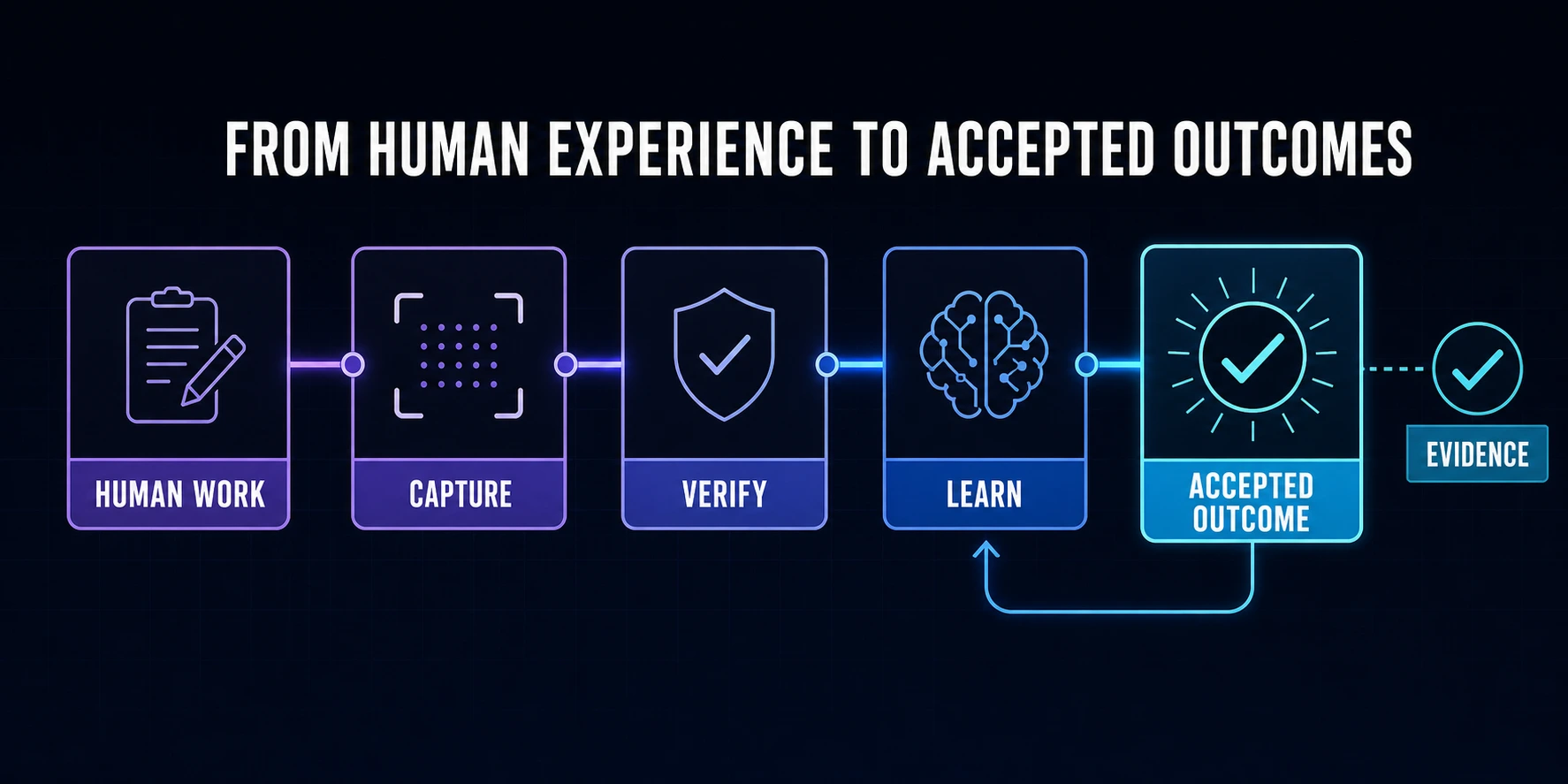
Figure 5. Real work produces evidence that improves the next round of AI-assisted work.
The company is no longer simply using AI.
Its operations are creating the data required to improve AI.
Human Data and Enterprise Intelligence Are One Continuous System
Human Data and Enterprise AI are often discussed as separate markets.
We believe they increasingly form one continuous improvement loop.
Real enterprise workflows produce:
real tasks,
real edge cases,
real failures,
real corrections,
real definitions of success,
and real accepted outcomes.
Those patterns can inform better evaluations.
Better evaluations improve model and workflow selection.
Better systems complete more work.
Difficult cases still reach humans.
Those interventions become new evidence.
And the cost per accepted outcome declines over time.
The valuable asset is not simply the underlying model.
It is the operating record surrounding it:
- customer-specific rules,
- workflow patterns,
- permissions,
- exceptions,
- corrections,
- graders,
- approval history,
- and acceptance standards.
That system becomes more useful every time work passes through it.
This Is the Larger Vision Behind AuraOne Enterprise Intelligence
Most traditional enterprise software records transactions.
AI-native infrastructure can record something much richer:
how work actually happened.
What entered the system?
What did the model attempt?
Which information did it inspect?
What did it change?
Where did it fail?
What did the reviewer correct?
Why was an output rejected?
What was ultimately accepted?
Which model and workflow version produced the result?
That operating memory creates something generic AI systems do not naturally possess:
A structured record of how this particular organization gets work right.
A wrong answer plus an approved correction becomes reusable evidence.
An exception becomes an evaluation.
A repeated edge case becomes a new workflow.
A reviewer decision becomes a quality standard.
Over time, the enterprise develops a proprietary intelligence layer around its own operations.
That can become a genuine moat.
Enterprises Ultimately Buy Outcomes
This leads to another important commercial shift.
The long-term unit of value in AI will not necessarily be:
the token,
the prompt,
the model,
or even the agent.
Enterprises buy completed work.
A retailer does not fundamentally want a catalog-cleaning agent.
It wants product records normalized, matched, deduplicated, classified and returned in an accepted state.
A finance department does not want an invoice chatbot.
It wants invoice exceptions investigated and resolved according to policy.
A procurement team does not want a research agent.
It wants supplier records completed, evidence attached, risks identified and decisions prepared.
A customer-service team does not care about autonomy in the abstract.
It wants cases resolved correctly.
The commercial unit moves closer to:
- a completed task
- an accepted record
- a resolved exception
- a verified workflow
- a finished business outcome
That is the foundation behind AuraOne Enterprise Intelligence:
Send us the work. Get the finished result.
Today each workflow opens as a scoped pilot.
The customer provides the work and defines what “done” means.
AuraOne coordinates the combination of models, tools, operating rules, evidence, expert review, exception handling and final acceptance required to get there.
The customer buys the outcome.
Not the machinery underneath it.
The Future Is Not Humans or AI
The transition toward autonomous work will not happen all at once.
Many real tasks contain:
incomplete information,
conflicting policies,
ambiguity,
sensitive decisions,
unusual exceptions,
and situations where automated verification is not yet sufficient.
The practical architecture is therefore not:
humans versus AI.
It is:
- AI performs the work it can complete reliably.
- Automated systems verify what can be verified.
- Uncertain cases are identified.
- Experts resolve the difficult exceptions.
- Final outputs are checked against acceptance standards.
- Corrections are preserved.
- The workflow improves over time.
As AI improves, the percentage of cases requiring human intervention should fall.
But accountability, escalation and acceptance remain important.
The goal is not to remove humans from every workflow.
It is to apply human judgment where it creates the highest value.
Better AI May Increase the Need for Better Data
There is a common assumption that sufficiently capable AI eventually removes the need for human-generated data.
We believe the opposite dynamic may continue for much longer than expected.
Better systems create higher expectations.
A model that can work for five minutes creates demand for one that can work for an hour.
An agent that handles routine tasks creates demand for one that handles difficult cases.
A robot that works in one environment creates demand for one that works everywhere.
A speech system that performs well in a quiet room creates demand for one that works in every condition.
Every capability opens another frontier.
And the last percentages of reliability can be much harder than the first.
Going from 50% to 90% is one problem.
Going from 99% to 99.99% may require learning an enormous long tail of rare events.
Those events become some of the most valuable data in the system.
Edge Cases Are the Frontier
Autonomous driving illustrates this clearly.
Driving down an empty highway is not the hardest problem.
The difficult situations are:
construction,
unexpected obstacles,
unusual weather,
emergency vehicles,
strange human behavior,
temporary road changes,
and events that may occur only once in millions of miles.
Professional AI will have the same long tail.
The unusual financial transaction.
The ambiguous contract clause.
The manufacturing failure nobody expected.
The customer request outside policy.
The scientific result that contradicts the expected pattern.
The object a robot has never encountered.
The speaker a voice model repeatedly misunderstands.
Those cases are not peripheral.
They define the next capability boundary.
Cheaper Intelligence Makes Verification More Valuable
Model access will continue becoming cheaper.
Inference will continue improving.
It will become economical to:
- run longer tasks,
- use several models,
- generate multiple possible solutions,
- and perform much more automated verification.
But cheaper intelligence does not automatically create reliable outcomes.
As model access becomes less differentiated, value shifts toward the surrounding system:
- task design,
- workflow integration,
- domain expertise,
- verification,
- permission management,
- evidence,
- independent evaluation,
- auditability,
- and accepted results.
The model becomes one component in a much larger operating system for trusted work.
For AuraOne, compute is an enabling layer.
The objective is not simply to use the largest model.
It is to use the appropriate combination of models, infrastructure, humans and verification to produce the lowest reliable cost per accepted outcome.
The Metrics Will Change Too
The AI industry has historically measured progress through:
parameters,
tokens,
benchmarks,
context windows,
latency,
and inference cost.
Those measures remain useful.
But they do not fully answer whether a system can reliably perform work.
The next generation of AI infrastructure will increasingly be measured through metrics such as:
- full task completion,
- accepted-output rate,
- human-intervention rate,
- verifier accuracy,
- error recovery,
- professional reviewer agreement,
- regression performance,
- time to completed outcome,
- cost per accepted task,
- and evidence completeness.
These metrics connect intelligence to economic value.
They tell us whether a system is merely impressive or genuinely dependable.
What This Means for AuraOne
AuraOne is being built around the idea that AI’s next challenge is not simply generating more intelligence.
It is turning intelligence into reliable work.
That requires several connected layers.
Human Data
Real professionals help define difficult work, create tasks, demonstrate expertise, expose failure boundaries, evaluate model trajectories and resolve ambiguity. Explore the Human Data work behind that layer.
Evaluation
Models and agents are tested against explicit definitions of success, including edge cases, regressions and long-horizon behavior. See the Evaluation Studio and Regression Bank surfaces for the evaluation thesis.
Synthetic Research
Models create scale, while expert judgment and real-world calibration keep generated data grounded.
Physical AI
Human activity becomes outcome-verified embodied experience through synchronized capture, demonstrations, failures, corrections and environmental context. AuraOne Capture is the product surface for that direction.
Voice AI
Speech becomes useful training material not only as audio, but as verified human interaction involving intent, meaning, context and successful completion.
Enterprise Intelligence
AI performs real operating work, difficult cases reach experts, corrections become memory and accepted outcomes improve the system over time. Explore Enterprise Intelligence for the operating-system view.
These are not disconnected product categories.
They are parts of one learning system.
The AuraOne Flywheel
The full loop looks like this:
- Real Work creates meaningful tasks.
- Human Expertise defines what good work looks like.
- Evaluation reveals where AI fails.
- Training Data and Environments teach the missing capability.
- Better Models and Agents complete more of the work.
- Enterprise and Real-World Deployment creates new cases, failures and outcomes.
- Corrections and Accepted Results become new evidence.
- The System Improves Again.
The same cycle can operate across professional reasoning, enterprise work, voice interactions and physical activity.
That is the larger opportunity.
The Next AI Company Is Not Just a Data Company
The traditional data company recruited people, distributed tasks, collected labels and delivered files.
The emerging infrastructure is different. It:
- begins with the capability,
- determines how success is measured,
- recreates the work,
- captures real expertise,
- creates training experience,
- evaluates complete trajectories,
- verifies the outcome,
- preserves failures,
- measures improvement,
- and then repeats the process.
The workflow becomes:
Capability Gap → Evaluation → Human Expertise → Environment → Training Experience → Verification → Improvement
That is not simply annotation.
It is not staffing.
It is not a synthetic-data generator.
And it is not conventional outsourcing.
It is a new layer of infrastructure connecting human activity to machine capability.
The World’s Largest Untapped AI Dataset May Already Exist
It is being generated every day:
- inside companies,
- inside factories,
- inside laboratories,
- inside hospitals,
- inside warehouses,
- inside financial institutions,
- inside software teams,
- inside conversations,
- inside homes,
- inside vehicles,
- and inside the hands of people doing physical work.
Humanity generates an extraordinary stream of actions, decisions, corrections and outcomes.
Historically, almost none of it was captured for the purpose of teaching machines.
Now it can be.
And increasingly, it will be.
The Internet Was the First Great Dataset for AI
The Internet taught AI what humans know.
The next frontier is teaching AI what humans do:
- how we reason,
- how we use tools,
- how we navigate ambiguity,
- how we recognize failure,
- how we recover,
- how we manipulate the physical world,
- how experts know when something is wrong,
- how organizations determine whether work is acceptable,
- and how successful outcomes are actually produced.
But observing work is not enough. The system needs:
- the objective,
- the context,
- the actions,
- the outcome,
- the correction,
- and evidence that the work was actually accepted.
That is the next data layer.
Verifiable human experience.
The first generation of AI learned from human knowledge.
The next generation will learn from human work.
AuraOne is building the infrastructure to make that work learnable, measurable and useful.