
Connect and inspect
Read the transport, the manifests, and the configured endpoints before you record a run.
AuraOne Open
Loading products, source links, and current releases.
AuraOne Open / Agent reliability
Connect MCP and A2A systems. Record the trace, replay the failure, and export a regression artifact. All from one local-first workbench.
For agent engineers who need the trace and the release evidence in the same decision path.
What you can do
Get started
Clone the repository, inspect transports and provider boundaries, then follow the current README for supported local setup.
git clone https://github.com/auraoneai/agent-studio-open.gitRead the transport, the manifests, and the configured endpoints before you record a run.
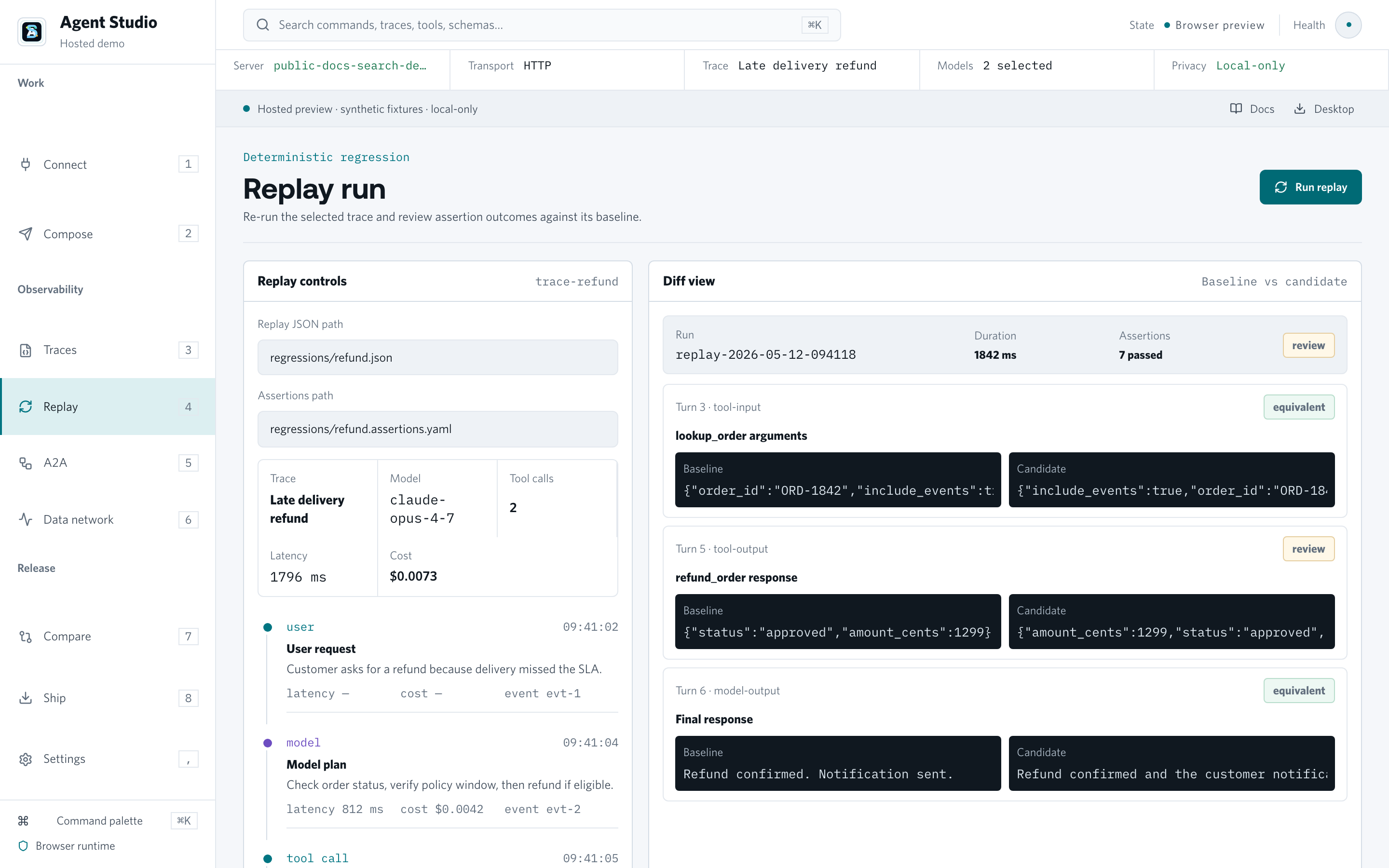
Tool inputs, outputs, and timing stay together with the deterministic replay case.
Run the same trace across model or prompt candidates and export CI-ready regression evidence.
See how the product moves from setup through a useful output.
01
Confirm the endpoint, the transport, and the runtime boundary.
Connection and manifest record
02
Capture the actual tool path. Outputs, timing, and retries come with it.
Portable trace card
03
Lock the relevant outputs and reproduce the failure under controlled conditions.
Replay example and assertions
04
Run the same case across model, prompt, or agent revisions and inspect the delta.
Behavior comparison
05
Publish regression artifacts only after source and release verification.
CI suite and release record
Overview
Review the current source, release, runtime, and support information.
Availability
Review the current version, source, packages, downloads, supported platforms, and install options.
Agent Studio Open, its browser workbench, and checksum-recorded macOS Apple Silicon release remain on product version 0.2.0. The release notes report Apple signing and notarization; this audit independently verified the GitHub digest, not the Apple trust chain. The PyPI CLI is 0.2.1 and the npm companion is 0.2.2.
macOS Apple Silicon / 0.2.0
GitHub serves this exact SHA-256 digest. The v0.2.0 release notes report Developer ID signing and notarization. They also report stapling and Gatekeeper acceptance. Those Apple trust checks were not independently rerun during the August 3 website audit.
SHA-256 30adbf96b107eb221cce5e07514f4ead7ce32046253f89dd5692f77c52c578caContinue exploring
Each one lists its source, current version, and install path.